

Hello!


MIMAROPA is a region in the Philippines consisting of the following provinces: Mindoro (Occidental Mindoro and Oriental Mindoro), Marinduque, Romblon and Palawan. These provinces are the provinces of Region IV-B islands in the ocean of the Western Philippines. There are only two cities in this entire region: Calapan City located in Oriental Mindoro and Puerto Princesa City in Palawan.
Palawan became part of Region VI on 5 June 2005. It was transferred to the Western Visayas from the former “MIMAROPA”, by virtue of Executive Order No. 429, signed on May 23, 2005.
Following this, Administrative Order No. was issued. 129 on August 19, 2005, to pay attention to any effect of the previous order and also to support the proper process of transfer of Palawan from the Western Visayas under MIMAROPA.
MIMAROPA or Region IV-B is a region in the Luzon region, with a total area of 27,455.9 square kilometers. This region consists of the provinces of Occidental Mindoro, Oriental Mindoro, Marinduque, Romblon and Palawan.

A long time ago, in a far away forest, the seed inside the cashew fruit often wonder about the world outside. One day, the seed heard some merriment and revelry of different animals in the forest and asked, “What is the cause of all the noise outside? Oh, if I can only release myself from this dark chamber!” He couldn’t do anything but listen and pray for his release.
A kind-hearted fairy, who joined the celebration heard his wish. The fairy took pity on the cashew nut and said, “You poor little thing! From now on, you will be outside this fruit so that you can enjoy the outside world” and in one gentle touch, the nut was immediately out of the fruit.
The seed was overwhelmed with the brightness and beauty of the outside world. He closed his eyes and savored the fragrance of the flowers and the gentle touch of the breeze. The seed was so excited that he wished that he would never return to the life of darkness that he used to live in. The fairy granted his wish.
The seed relished the sight of the festivity and enjoyed the world around him. However, after a few hours the revelry stopped and the animals started to retreat, hoping to take shelter. In a moment, the sky was filled with dark clouds, the wind blew hard and rain fell heavily. The heavy raindrops painfully hit his skin, the gentle breeze is now a strong gust of wind that seems to sweep him away from the fruit that used to be his shelter and the deafening thunder and lightning raised his fear even more.
The seed called the fairy and begged to return him back to his old shelter where he is safe. The fairy seems to be nowhere in sight and nobody seemed to hear his plea. Once the storm has stopped, the fairy once more appeared and saw the seed begging to be returned to his chamber.
The fairy said, “I will not return you to your chamber, I want to teach you a lesson. Be contented with what you have. Appreciate whatever God has given you.” Then the fairy left.
From then on, the cashew nut can be found outside the fruit unlike all other fruits.

In a small island kingdom there once lived a very beautiful princess. She was nicknamed Maring. Her favorite haunt was the top of a very tall mountain, Mount Malindig. She was very fond of hunting wild animals, a diversion which was much against her father’s wish. One day she espied a pretty white deer. It ran so swiftly that it took her a long time to catch up with it. She had the game already at bay when the owner came along looking for it. The stranger was a man of princely bearing and fine manners. He introduced himself as Duque and the deer to her as offered a token of their first meeting. Maring could not resist his gallant gesture. She could not help admiring the stranger, who fell in love with her at first sight. Since that day they often met in the forest. The beauty of Maring was known far and wide. Innumerable suitors came to woo her, but she turned a deaf ear to them all, for she had set her heart on the modest Duque. Not knowing about her secret love affair, her royal father announced that her hand would be given to the one who would win a ship race. So the most persistent suitors, three wealthy kings, fitted out vessels for the contest. Duque could not participate. He was not rich enough to equip a vessel.
Meanwhile, Maring was very unhappy. She prayed to the gods for help. Bathala heard her prayers. On the appointed day, the sky grew suddenly dark. The sea seethed turbulently and the winds blew furiously, but the contest could not be put off for another day. The three kings set forth bravely on their ships. Before they were halfway to the goal, one of them hit a rock and soon vanished from sight with his ship. The second vessel was able to move on a little farther and then it was also devour by the angry sea. The last ship met the same fate. The king and the spectators grieved over the fate of the three royal suitors. Only Maring did not feel grieved at the outcome of the race. When the sea calmed down, everyone was surprised to see three islands at the places where the ship had sunk. They were named Tres Reyes, or Three Kings, after the unlucky trio. The father of Maring did not wish to sacrifice more lives after that disaster. He gave his daughter freedom to choose her husband. So she confessed to him her secret love. The king consisted to the marriage. Seven days of feasting and merrymaking followed. To mark the happy union of the two young people, the island kingdom was named Marinduque, after Maring and Duque.
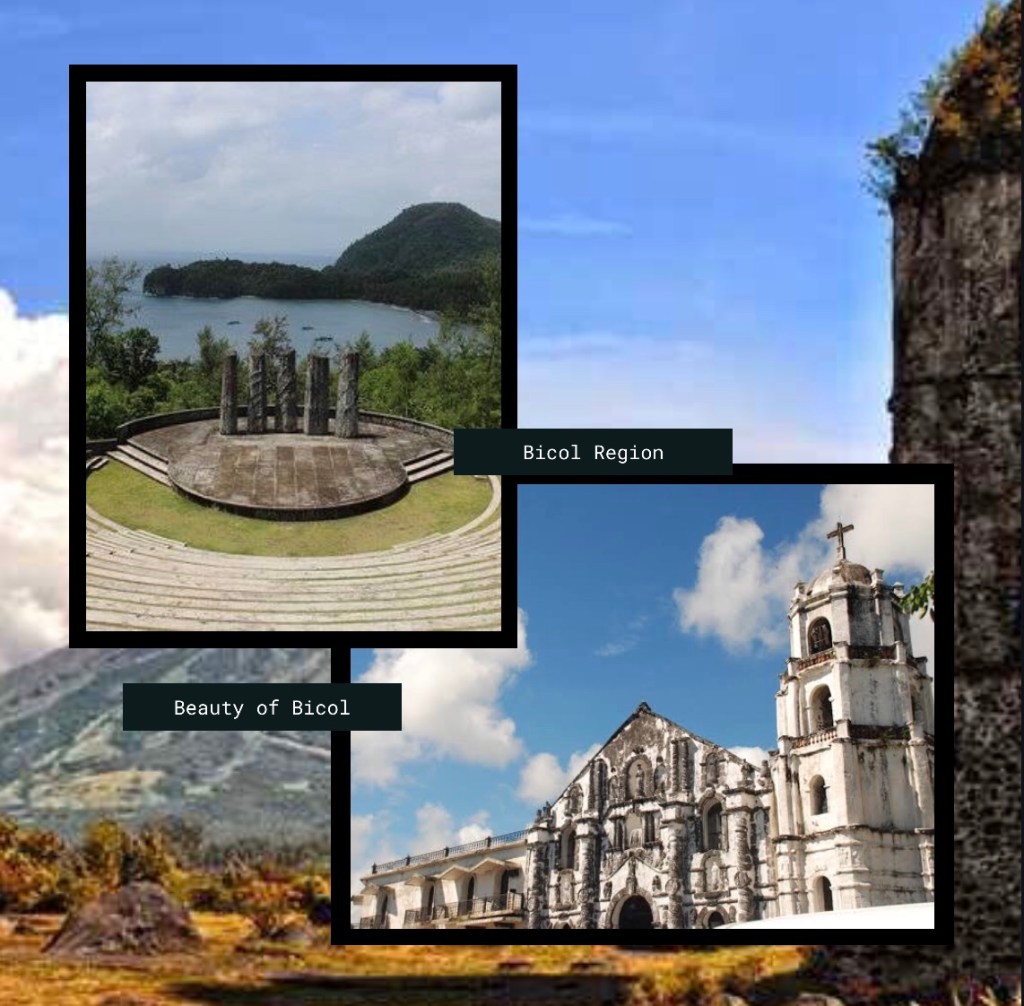
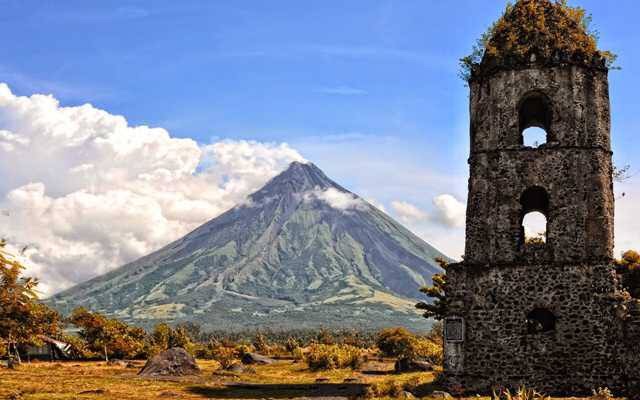
The Bicolanos live in the provinces south of Luzon Community namely Camarines Norte, Camarines Sur, Catanduanes, Masbate, Albay and Sorsogon. With large tracts of land, farming has become the chief occupation of the people. They also engaged in fishing, logging, cattle-raising and handicraft.
The Bicolano is conservative. They believe it is safe to stick to the old than take a risk in the new. To some extent however, the educated Bicolano has begun to change gradually.
His way of life resembles those of the other people of Luzon. He loves songs and dances. In them, he expresses his feeling and sentiments. He spends his leisure time dancing, singing, playing musical instrument like the guitar, and in cockfighting. He also plays game similar to those played by Tagalogs.
More info. Check the references 😊
Thousands and thousands of years ago, there was a time when the space occupied by the universe was vacant. The moon, the sun, the stars, and the earth were conspicuous by their absence. Only the vast expanse of water and the sky above it could be seen. The kingdom of the sky was under the rule of the great god Languit, while the water was under the sovereignty of the god Tubigan.
Languit had a daughter called Dagat, the sea, who became the wife of Paros, the wind , who was the son of Tubigan.
Four children were born to Dagat and Paros, three of whom were boys called Daga, Aldao, and Bulan, and one girl called Bitoon.
Daga, a strong man, possessed a body of rock; Aldao, a jolly fellow, had a body of gold; Bulan, a copper-made man, was a weakling; while the beautiful Bitoon was made of pure silver.
After the death of their father Paros, Daga, being the eldest son, succeeded in control of the winds. Soon after, Dagat, the mother died, leaving her children under the care of the grandparents Languit and Tubigan.
After assuming control of the winds, Daga became arrogant and ambitious, desiring to gain more power, so he induced his younger brothers to attack the kingdom of Languit. At first they refused; at Daga’s anger, Bulan and Aldao were constrained to join him in his plot.
Preparations were made and when everything was ready, they set out on their expedition and began to attack the gates of the sky. Failing to open the gates, Daga let loose the winds in all directions so that the gate was destroyed and the brothers succeeded in gaining entrance. But they were met by the enraged Languit who set out three bolts of lightning after them. All of them were struck by lightning. The copper body of Bulan melted into a ball; so also was the golden body of Aldao. Daga’s body fell into the sea and became what is now the earth.
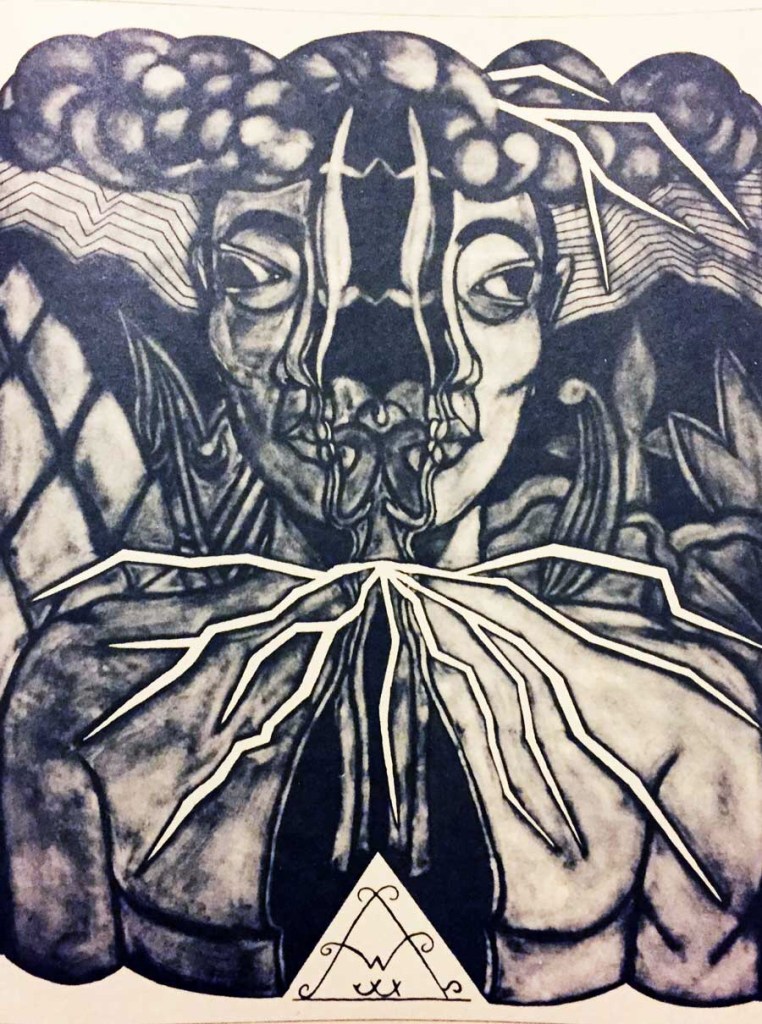
Their sister Bitoon, on discovering the absence of her brothers, went out to look for them. But upon meeting the enraged god Languit, Bitoon was also struck by another bolt of lightning which broke her body into many pieces.
Then Languit descended from the sky and called Tubigan and accused him of helping their grandsons in their attack on his kingdom. But Tubigan defended himself saying he had no knowledge about the attack for he was asleep far down into the sea. Tubigan succeeded in pacifying Languit and the two regretted and wept over the loss of their grandchildren. Since they could not revive them, they gave each body a light.
Tubigan then planted a seed which grew into a bamboo tree. From one of its branches came a man and a woman, who became the first parents of the human race. Three children were born to them. One called Maisog invented a fish trap. One day he caught such a very big and grotesque looking whale that he thought it was a god, so he ordered his people to worship it. The people gathered around and began to pray; but no sooner they had begun, when gods from the sky appeared and commanded Maisog to throw the whale to the water and worship no one but the gods. But Maisog was not afraid and defied the gods. Languit, the king of the sky, struck Maisog with lightning and stunned him. Then he scattered the people over the earth as a punishment. In this way the earth was peopled.
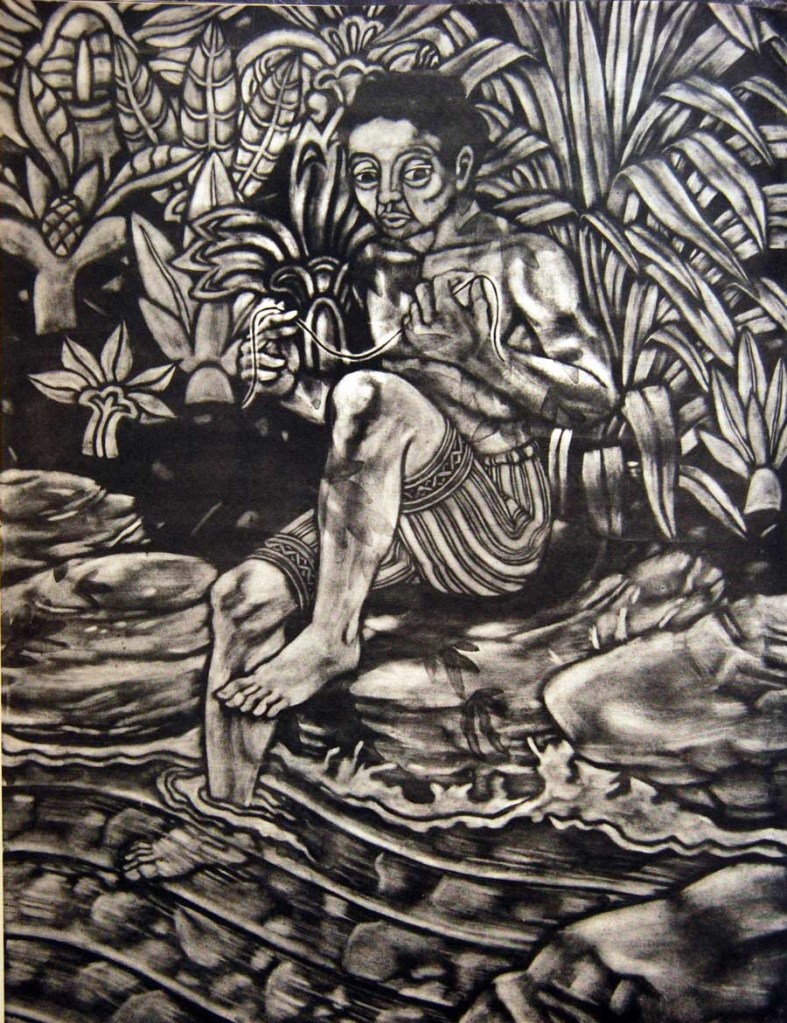
Maisog’s body was blackened by the lightning and all his descendants are black. But Maisog’s son was carried to the north and became the parent of the white people. His other children were brought to the south where the sun was hot and it scorched their bodies so that all their people were of brown color. The other people were carried to the east where they had to feed on clay due to scarcity of food. Because of this diet, their descendants were of yellow color.
In this way the earth came into being.
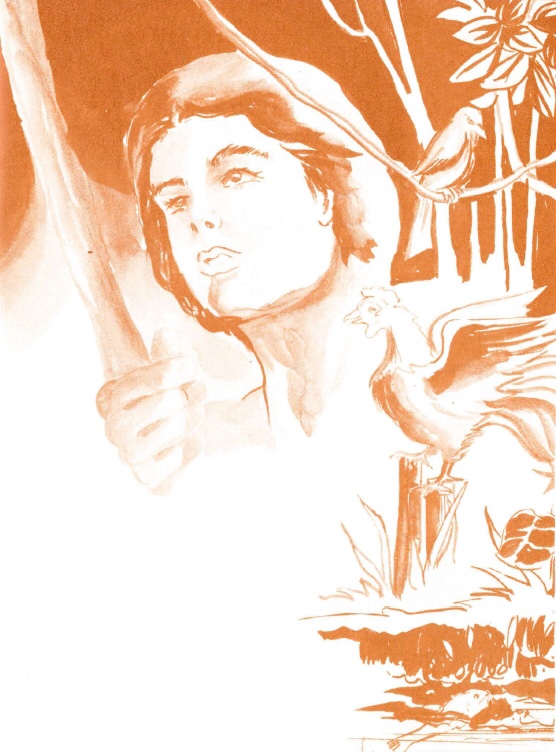
LONG, LONG AGO, SOMEWHERE IN THE Bicol Region, existed a prosperous and beautiful kingdom called Ibalon. It was renowned for its lush forest, happy inhabitants and mighty ruler, Handyong. All nature adored Handyong. The Mayas chirped about their handsome and wise ruler; while Maribok, the king-frog, croaked day and night of Handyong’s bravery. Tuktok, the mother Kalaw, as she taught her baby horn bills how to peck faster, described to them how Handyong’s muscles glistened under the sun. Even Poringot, the bald rooster, would wiggle his tail to honor Handyong. Bolinao, the chief of small fishes, would lead the school of fish to the farthest nook of the sea telling all the creatures they met how good a fisherman Handyong was.
The people of Ibalon were very grateful that Handyong was not only handsome, but also brave.
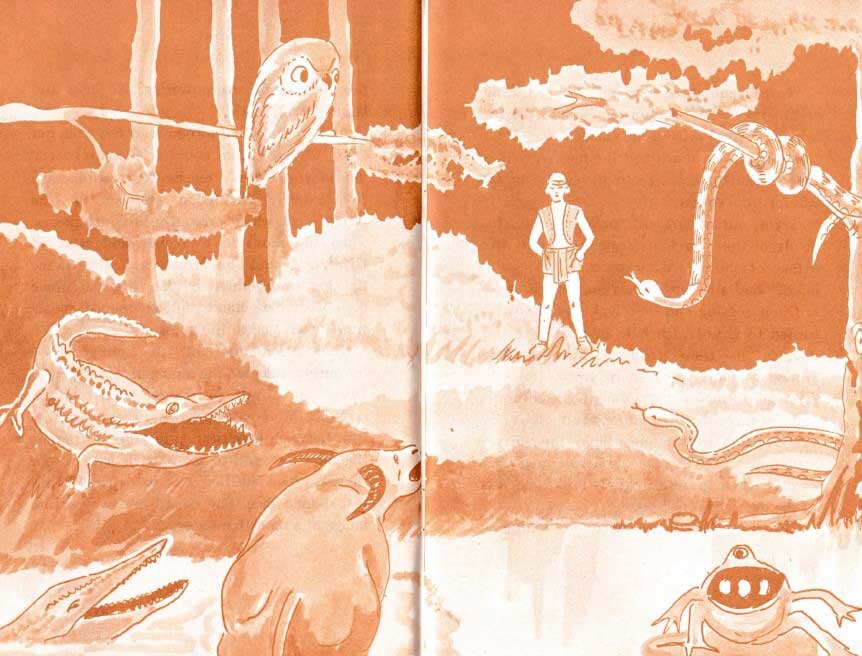
But the much-adored Handyong was terribly unhappy, for deep in the forest lived monsters. Punong-the one-eyed, three throated creature, the wild carabaos, the gigantic crocodiles and the snakes that lived in Mount Hantik were his enemies. These beasts were led by the wily serpent, Oryol, who was difficult to destroy, for she was more cunning than Handyong.
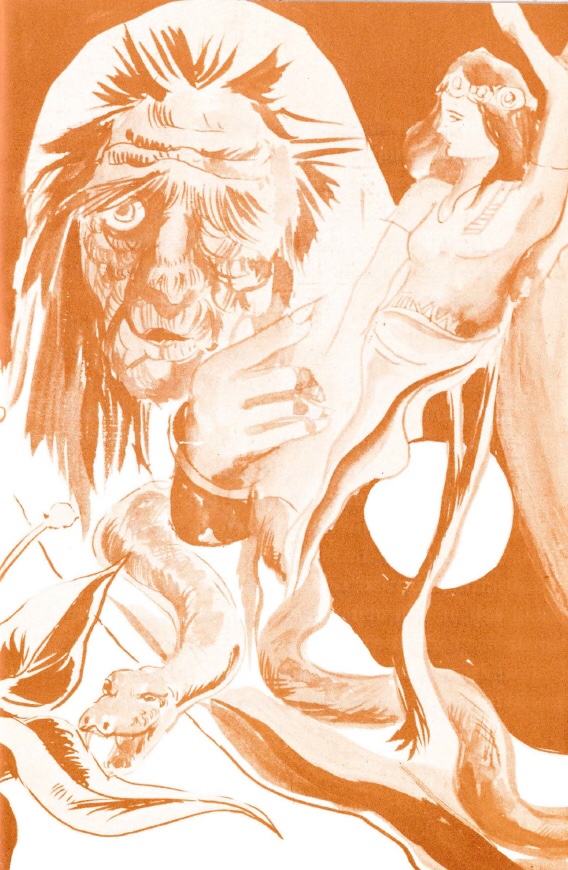
Oryol was once the most beautiful maiden of lbalon. Envious of her beauty, Hilang, the evil witch, lured Oryol to the forest and converted her into a serpent by day and a lovely woman by midnight. Hilang vowed on a pitogo seed that only love could free Oryol from the curse. The promise was sealed in the enchanted pitogo, and only its destruction held the key to Oryol ‘s freedom.
One night, when the moon showed its round face, the monsters attacked the village, destroyed the crops and preyed on the people. Handyong single-handedly fought the monsters from midnight to dawn. It was only when the sun kissed the earth that the monsters retreated to the woods. They left Handyong alone, sore and bone-weary. Although his people applauded his brave deeds, he was still not quite happy because he knew the monsters would return the next full moon and he was afraid he might not be always as strong to fight them everytime they
attack his kingdom.
Handyong decided to go deep into the forest and wrestle once and for all with the monsters.
Meanwhile, in the forest where the monsters gathered anew to make their evil plans, the other animals shook like leaves in fright as they listened to the harsh words as each one blamed the other for their defeat in the previous encounter with Handyong.
“You and your noisy throat! How could you move fast? You should have asked your grandmother for three eyes and one throat instead,” one snake addressed Punong.
The monstrous frog’s throats expanded in anger and his eye winked malevolently, as he croaked. “How dare you drag my grandmother’s name into the fight! If not for Handyong’s attempt to strangle one of my throats, you wouldn’t have escaped!”
So the dispute continued. The wild carabaos could only blame their thick hide for their limited body movement. The gigantic crocodiles accused one another for stupidly getting snarled in each other’s jaws. They fought fiercely only to discover that the scaly bodies they bit were as tough as their own.
But Oryol, the wily serpent, after listening to the arguments, smiled and hissed.
“I will destroy Handyong, not by might but by wit. Leave me alone to think,” she said, her two-pronged tongue flashing in anger. Like a queen, Oryol slid down the tree, coiled and poised her regal head, ready to strike anyone who disobeyed.
When the monsters had gone to their respective hotbeds of wickedness, Oryol felt very lonely. Many volcanic eruptions and countless typhoons had passed, and she had gotten tired of the wasted time spent on schemes to kill Handyong. She was disgusted at the ranting and the swearing among the monsters. She had shed off her silvery skin as many times as the ancient balete trees in the forest since the evil witch Hilang turned her into a snake. Having forgotten who her real enemy is, her serpent heart vowed to kill Handyong or be killed by him.
Days flew fast and the night lantern once more was beginning to be as round as a pomelo when Oryol restlessly awakened. The light which poured in between hollows in the forest imbued in her heart the desire to be free from darkness. With her low seductive voice, she hissed her serpent song, paralyzing and terrifying all creatures who heard it. Even the night owls ceased hooting while their eyes grew wider in wonder.
As Oryol finished her song, she slowly opened her eyes to discover a transformation. She now had hands, with fingers that tapered beautifully like candles. She smoothed her silken black hair down her small, round waist. She noticed a pair of firm young legs, both eager to explore the dark forest. Unaware of her ravishing looks, Oryol approached one of the owls. When she looked into its wide eyes she saw her startled reflection. Hesitantly, afraid that the image might vanish, she brushed lightly her moonwashed face.
While she talked to the owls, the dangling monkeys whooped resounding cries. They smelt someone coming. Silently, like a cat stalking its prey, Handyong came into view. He had come with his followers to track down the monsters of Mt. Hantik. Handyong himself stood in awe at the beautiful apparition before him. Oryol ‘s heart quivered with excitement as she encountered Handyong’s penetrating eyes. She thought she had forgotten how to love!
But she quickly recovered and remembered her vow to kill Handyong. “I will lure him into forgetting his purpose for coming. I will sing to him until he ceases to remember, and then . . . ” she muttered to herself. She fingered the enchanted pitogo seed in her hand.
“Young woman, you’re alone in the forest, are you not afraid of the monsters lurking in the dark?” Handyong asked her.
“Monsters?” she replied. “They have been lulled to sleep by my song. Come, I’ll show you where they are.”
She led him to where the monsters were sound asleep. Handyong could have easily attacked them but did not think it honorable to kill a defenseless enemy. He instead decided to let his men rest until the monsters awakened from their slumber.
Oryol resumed her humming, then burst into an enchanting song. The men’s lids dropped as though mesmerized. Soon they were fast asleep. Only Handyong fought the urge to drift into dreamland. His eyes were on the lovely Oryol.
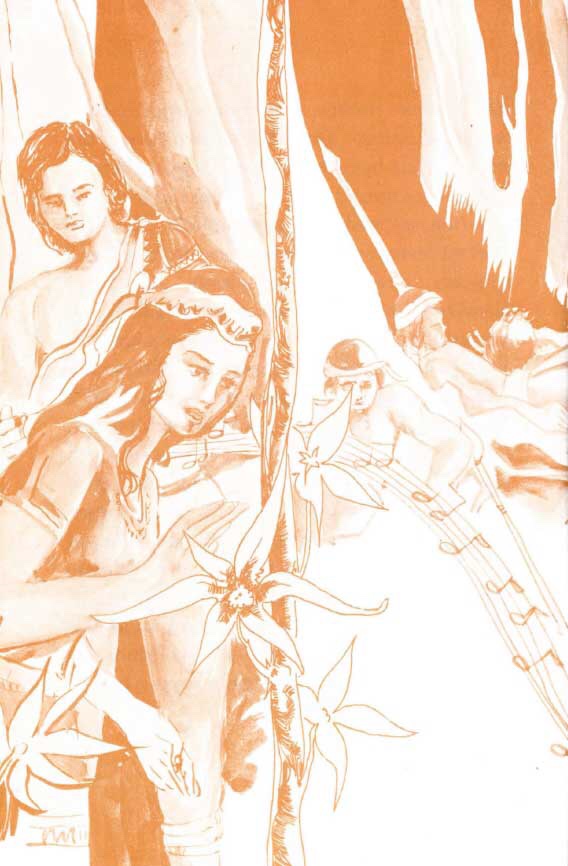
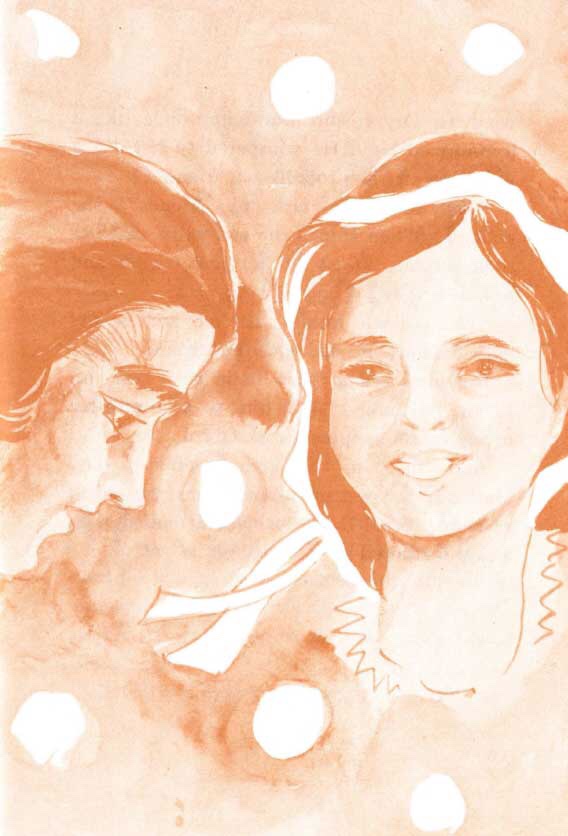
After a while, Oryol thought she had tricked everyone and once more became a serpent. She crept noiselessly to where Handyong lay. But Handyong, who had seen everything, was · ready to defend himself. Before Oryol could -strike him, swift as the wink of an eye, he grabbed the serpent’s neck so tight that Oryol thought it would break. Just as she was about to pass out, she again changed into a beautiful lady. Handyong, who had never hurt a woman in his life, released his grip and with powerful arms carried Oryol to a bed of leaves and tenderly laid her down. Oryol is human, he thought, -not a monster. No monster could be lovely and defenseless as she is now. And love came to Handyong unexpectedly, quiet like the morning ball of fire, warm and overpowering. He bent and kissed Oryol.
As he did so, the pitogo seed fell from her hand. The seed that could spell the monters’ defeat and Oryol ‘s release from witchcraft. Accidentally, Handyong stepped on the pitogo seed which promptly broke to pieces. Then the monsters awakened and attacked Handyong and his followers. The fierce fighting reverberated in the forest as brave men with bare hands and sharpened spears were pitted against the monsters.
The destruction of the pitogo seed instantly weakened the monsters and deprived Oryol the power to convert herself into a serpent. Moreover, Oryol ‘s heart was now torn between loyalties: to her former friends, the monsters, and to the mortals with whom she was now identified. Pain was etched in her tear-stained face. She closed her eyes to the image of a slain Handyong.
“No, I cannot see him hurt or dead,” she cried softly. “These monsters should die for bringing untold evils to the villagers.”
It was almost dawn and the men as well as the monsters had gotten tired, but the battle was far from ended.
Oryol, out of concern for Handyong, also divulged the secret strategy to hasten the defeat of the cursed monsters. “Aim at the heart,” she cautioned Handyong and his men.
Upon sensing this betrayal, the monsters turned to Oryol with hate in their eyes and distaste in their frothing mouths. The crocodiles bared razor-sharp teeth, the wild carabaos formed a battalion of poised horns and the three-throated Punong rotated its one eye swiftly. In the meantime, the shifted attention to Oryol gave the heroic men time to drive their spears forcefully into the hearts
of the deceived monsters.
The violent battle having ended, Handyong went to Oryol who stood immobile like a hypnotized lady. He whispered to her, “Are you sorry, we had to kill your friends?”
“They ‘re really not my friends,” she sobbed. “When Hilang the evil witch cast her spell on me, I lost all my real friends and home.”
“Please come home with me and be my wife,” Handyong said with tenderness.
His men seeing that their ruler will no longer be lonely, left him to celebrate his newly found happiness with Oryol.
And so, on the great wedding day, Maribok, Kalaw and Bolinao came dressed in colorful attire. Even Poringot attended with a tiny feathered hat perched on its tail.
 Luzon 2